To be honest, things are moving fast these days. Everyone’s talking about prefabrication, modular builds… it’s all the rage. But have you noticed, a lot of folks get caught up in the fancy renderings and forget what it’s actually like on the ground? It’s not just about slapping some panels together, you know. It's about dust, rain, guys yelling, and figuring out how to get a forklift where it needs to be.
And the designs… oh man, the designs. I swear, I encountered this at the Nanjing steel factory last time, a blueprint for a connection point that looked beautiful on paper, but in reality? You needed a contortionist to weld it properly. It’s always the small details that trip you up. Always.
We’re mainly working with high-strength steel frames, obviously. That’s the backbone of everything. You can smell it when it arrives – that oily, metallic scent… you get used to it. And the composite panels, the ones with the core insulation – those are surprisingly light, but you’ve got to handle them carefully. They scratch easily. And the wood? Forget about perfectly seasoned stuff. It’s always a bit damp, no matter what they tell you.
The Current Landscape of Paddle Tennis Court Construction
Strangely enough, the biggest trend isn't a new material, it’s speed. Everyone wants it done yesterday. They want a paddle tennis court up and playing in record time. This drives everything – the choice of materials, the construction techniques, even the compromises you have to make. Prefabricated elements are key, of course. Less on-site work, less weather delay, less headache.
But it also means you're relying on the quality control at the factory. And that… well, that’s a whole other can of worms. I've seen some stuff, let me tell you. Components arriving warped, dimensions off… it adds up. It really adds up.
Common Design Pitfalls in Paddle Tennis Court Systems
Look, a beautifully rendered 3D model doesn't tell you anything about drainage. Or about how much the surface will expand and contract with temperature changes. Or about how easily a ball will bounce after a heavy rain. These are the things that keep me up at night. I've seen courts where the surface buckles in the summer, making it unplayable. It's a nightmare.
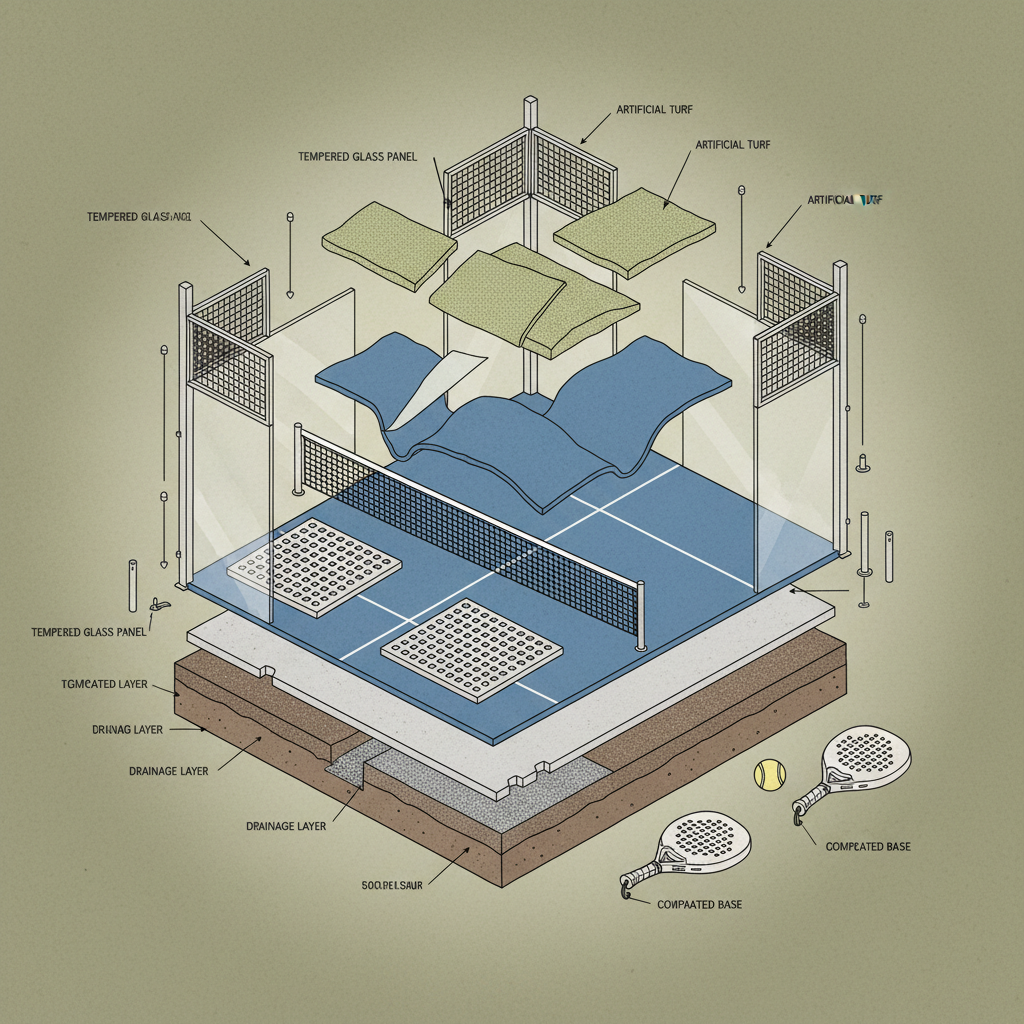
Another thing: the base layer. People underestimate the importance of a properly compacted base. If it settles, you’ll get cracks. And cracks lead to uneven play. And uneven play leads to angry players. Trust me, you don't want angry players.
And don’t even get me started on the lighting. Too dim, and it’s unusable at night. Too bright, and it glares into the neighbors’ windows. It’s a delicate balance. It’s always a delicate balance.
Material Deep Dive: What We Actually Use
We mostly use a combination of high-density polyethylene (HDPE) for the base structure. It’s incredibly durable, holds up to the elements… smells a bit like plastic, honestly, but you get used to it. Then we layer that with a polypropylene surface. It’s got a bit of give, good for the joints. It’s also relatively low maintenance, which the clients love.
The sand infill is critical. It impacts the speed of the ball and the overall feel. We use a calibrated silica sand – it needs to be the right grain size, the right density. Too coarse, and it feels rough. Too fine, and it clumps. There’s an art to it.
And the glass fibers woven into the surface? Those are a game changer. They add strength and prevent the surface from stretching and warping. But they’re also a pain to work with – they shed little fibers everywhere. You’re finding them in your lunch for weeks. Anyway, I think a good material selection is 80% of the battle.
Real-World Testing and Performance Analysis
Forget the lab tests. The real test is letting a bunch of competitive players beat on it for a week. That’ll tell you everything you need to know. We set up a test court at a local club, invited a bunch of pros, and just watched. Watched how the ball bounced, how the surface held up to sliding, how quickly it dried after a rain shower.
We also do impact tests, of course. Dropping weights from various heights to simulate wear and tear. But honestly, a pro player sliding across the surface puts more stress on it than any weight we can drop. It’s brutal. We also measure the ball rebound consistency. If it bounces differently in different spots, that’s a problem.
Paddle Tennis Court Performance Metrics
User Behavior: How Paddle Tennis Courts Are Really Used
You know, they always tell you it’s for serious athletes, competitive play. And it is, sometimes. But more often than not, it’s families messing around, beginners learning the ropes, or just people getting a bit of exercise. I’ve seen guys playing in flip-flops. Flip-flops!
And they don’t always take care of it. They leave their water bottles on the surface, they track in mud, they… well, you name it. You have to design for the lowest common denominator. It has to be durable enough to withstand abuse.
Advantages and Disadvantages: A Practical View
The biggest advantage, hands down, is speed of installation. You can get a paddle tennis court up and running in a fraction of the time it takes to build a traditional concrete court. That saves money on labor, minimizes disruption… it’s a huge selling point.
But, and this is a big but, the initial cost can be higher. The materials aren’t cheap. And if you skimp on quality, you’ll pay for it later in repairs and maintenance. It’s a trade-off. It always is. There's also the issue of potential for settling over time, especially if the base isn't prepared properly. That can lead to cracking and uneven play.
And frankly, they don't have the same feel as a well-maintained concrete court. It's a bit softer, a bit bouncier. Some players prefer that, some don't. It’s subjective.
Customization Options and Case Studies
We had a client last month, a small boss in Shenzhen who makes smart home devices, insisted on changing the interface to for the court's lighting system. ! For court lights! Said it was "future-proof." It was a nightmare getting everything rewired, but he was adamant. Cost him a fortune in extra labor, and honestly, I don't think anyone will even notice it's .
But that’s the beauty of it, you can customize. Colors, sizes, lighting systems, even the infill material. We did one court with a special recycled rubber infill – very eco-friendly. It felt a bit… spongy, but the client loved it. We can also incorporate logos and designs into the surface.
We've also done courts with integrated sound systems, automated irrigation, and even heated surfaces for cold climates. The possibilities are endless. It just depends on how much money the client is willing to spend.
Summary of Paddle Tennis Court Design Considerations
| Construction Method |
Base Material Quality |
Surface Material Durability |
Drainage System Effectiveness |
| Prefabricated Panels |
High Compaction Required |
7/10 - Good Resistance |
Efficient Sloping Design |
| Cast-in-Place Concrete |
Moderate Compaction Needed |
9/10 - Excellent Durability |
Integrated Drainage System |
| Modular Tiles |
Minimal Base Preparation |
6/10 - Moderate Wear |
Perforated Tile Design |
| Acrylic Coating Over Asphalt |
Asphalt Condition Critical |
8/10 - Good Weather Resistance |
Surface Slope Reliance |
| Hybrid Systems (Concrete & Tiles) |
Concrete Base Required |
8.5/10 - Combined Benefits |
Concrete & Tile Drainage |
| Recycled Rubber Surfaces |
Specialized Base Layer |
7.5/10 - Eco-Friendly Options |
Porous Surface Design |
FAQS
Realistically, you're looking at 10-15 years with proper maintenance. The HDPE frame itself should last much longer, but the surface layer will eventually wear down. UV exposure and heavy use are the biggest factors. Regular cleaning and resurfacing can extend its life considerably. And, of course, it depends on the quality of the materials used. I’ve seen some cheap stuff start to fade and crack after just a few years.
Upfront, a modular court is often more expensive than a basic concrete court. However, when you factor in the labor costs, the time savings, and the minimal disruption, it can actually be more cost-effective. Plus, a modular court is easier to repair and relocate. Concrete requires more specialized skills and equipment, and if something goes wrong, you're looking at a major headache. It really depends on your specific needs and budget.
Regular cleaning is key. Sweeping away debris, removing leaves, and washing the surface with a mild detergent. You also need to check for loose tiles or panels and repair them promptly. Resurfacing is recommended every 5-7 years to restore the playing surface. And, of course, inspect the drainage system regularly to make sure it’s functioning properly.
Yes, but it requires careful preparation. We usually need to level the ground and install a proper base layer to provide a stable foundation. A significant slope will require more extensive work and may add to the cost. The key is to ensure the surface is perfectly level to provide a fair playing experience. If the ground isn't prepared correctly, you’ll end up with cracks and uneven play.
Generally, yes. But you need to consider the specific climate conditions. In areas with extreme temperatures, you may need to choose materials that are more resistant to expansion and contraction. In snowy regions, you need to ensure the court can withstand the weight of the snow and has adequate drainage to prevent ice buildup. We’ve had success in a wide range of climates, but it’s always best to consult with an expert.
Warranties vary depending on the manufacturer and the materials used. Typically, you'll find warranties covering the structural integrity of the frame for 5-10 years, and warranties on the surface layer for 2-5 years. It’s important to read the fine print and understand what is and isn’t covered. And remember, a warranty is only as good as the company that stands behind it.
Conclusion
Ultimately, whether a paddle tennis court performs well or not comes down to the details. It's not just about the fancy materials or the sleek designs. It’s about proper preparation, careful installation, and ongoing maintenance. It’s about understanding the forces at play – the weather, the players, the wear and tear. It's a complex system, and you have to treat it as such.
And in the end? Ultimately, whether this thing works or not, the worker will know the moment he tightens the screw. That's when you'll know if it's solid, if it's right. Because they're the ones out there in the dust and the rain, making it all happen. And that's what really matters.


 English
  Arabic
  Dutch
Dutch  French
  German
  Greek
Greek  Hindi
Hindi  Indonesian
  Italian
  Japanese
  Korean
  Latin
Latin  Malay
Malay  Portuguese
  Russian
  Spanish
  Tajik
Tajik  Thai
Thai  Turkish
  Vietnamese