When looking to buy padel court systems, facility operators and sports enthusiasts must navigate a complex landscape of structural engineering and material science to ensure a long-term return on investment. In the specialized field of sports facility manufacturing, a court is not merely a playing surface but a precision-engineered environment that balances safety, durability, and professional performance standards.
The primary challenge for buyers is often distinguishing between standard court builds and high-performance installations. Issues such as corrosion in outdoor environments, glass safety under high-impact play, and the degradation of artificial turf can lead to significant maintenance costs if the initial procurement specifications are inadequate.
This professional analysis provides a comprehensive framework for evaluating padel court specifications, from hot-dip galvanized steel structures to the selection of FIP-recognized monofilament turf, helping buyers make an informed procurement decision based on technical merit and operational longevity.

Critical Structural Material Standards

The longevity of a padel court depends almost entirely on the treatment of its steel frame. For professional installations, hot-dip galvanized steel is the industry benchmark because it creates a metallurgical bond between the zinc and the steel, providing a robust barrier against oxidation. This is particularly critical for courts located in humid or coastal regions where salt-air corrosion can compromise structural integrity within a few seasons.
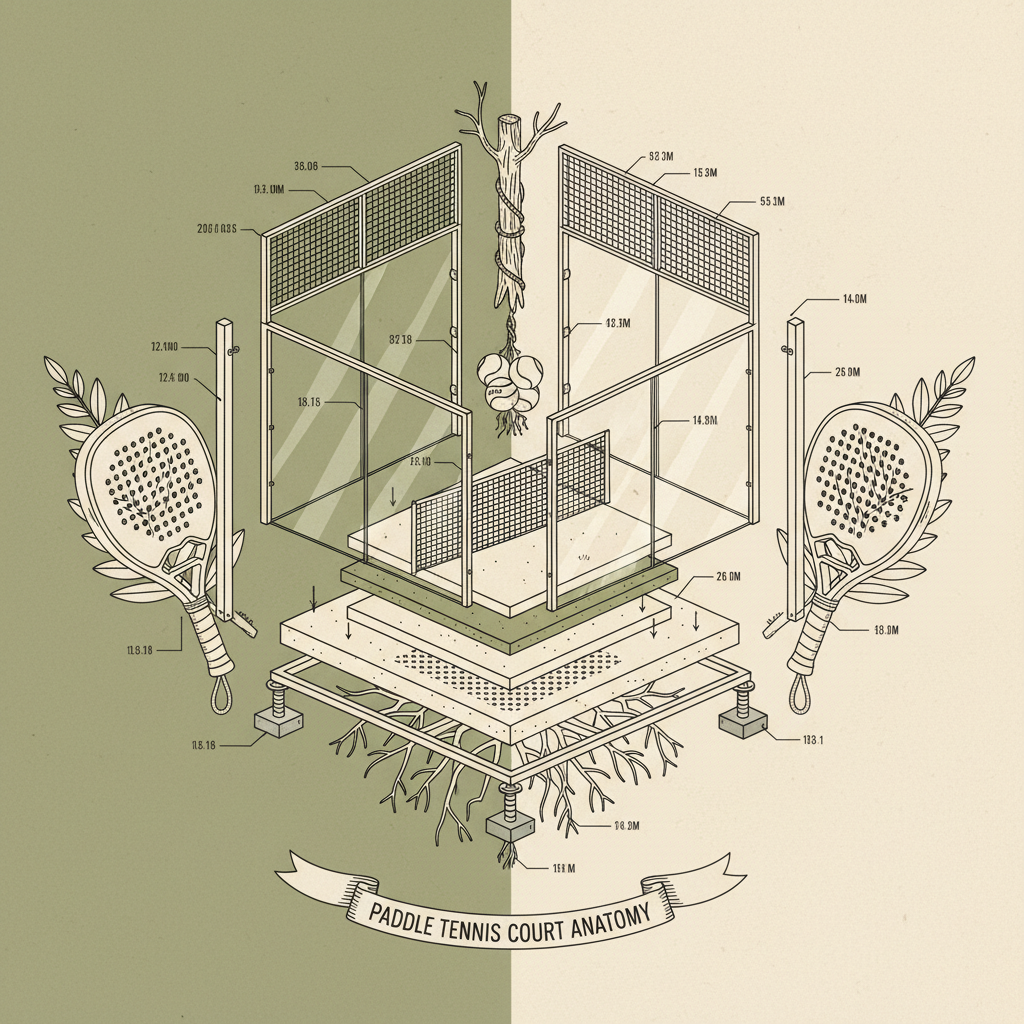
To further enhance protection, the application of a high-quality spray coating over the galvanized layer adds a secondary defense mechanism and allows for aesthetic customization. A standard professional frame, such as those utilizing 1001003mm columns, ensures the necessary rigidity to withstand the constant impact of players and balls against the glass walls without shifting or vibrating.
Glass Safety and Impact Specifications
When you buy padel court components, the glass specification is the most critical safety variable. Tempered safety glass is mandatory; it is engineered through controlled heat treatment to be four to five times stronger than standard glass. This ensures that the walls can absorb the high-velocity impact of a padel ball and the accidental weight of a player during a match.
A key safety feature of professional tempered glass is its fracture pattern. In the rare event of a complete failure, the glass is designed to shatter into small, granular pieces rather than sharp shards, drastically reducing the risk of severe injury. Buyers should verify that the glass thickness and tempering process meet international safety certifications to ensure a secure environment for all skill levels.
Turf Selection and Performance Metrics
The playing surface directly affects the game's speed, player joint health, and overall stability. Modern professional courts utilize monofilament artificial turf, which is preferred over older fibrillated options due to its superior resilience and consistency. The 12mm to 15mm monofilament turf, such as MONDO STX types, provides the necessary grip and ball bounce required for competitive play.
Color selection is not merely aesthetic; official colors recognized by bodies like the FIP, FEP, and WPT (such as blue, green, red, and purple) are designed to provide optimal visual contrast for the ball. A high-quality turf system must be crash-resistant and stable, preventing the surface from shifting under the lateral movements typical of padel, thereby reducing the risk of ankle and knee injuries.
Evaluating Facility ROI and Durability
For facility operators, the decision to buy padel court installations is an investment in revenue per square meter. The ROI is driven by the court's uptime, which is a direct result of the chosen materials. Low-grade steel or thin turf leads to frequent closures for repairs, while high-spec materials ensure a consistent, premium experience that justifies higher booking rates.
The following conceptual analysis illustrates the relative impact of different quality tiers on long-term operational costs. While higher initial investment in galvanized steel and premium turf increases the upfront cost, it significantly reduces the normalized maintenance score over a 5-year period.
Customization Framework for Operators
Professional sports facility manufacturing allows for significant customization to match specific brand identities or environmental needs. Buyers can adjust column specifications (e.g., 80803mm vs 1001003mm) and turf heights (10mm, 12mm, or 15mm) based on the expected intensity of use and the desired speed of the game.
Beyond structural dimensions, the visual identity of the court—including the frame color (black, green, orange, or custom) and the turf color—plays a role in the facility's marketing appeal. Yocool provides these customization options to ensure that the courts integrate seamlessly into the existing architecture of a sports complex while maintaining international standard dimensions of 10m20m.
Common Procurement Risks to Avoid
One of the most frequent mistakes when seeking to buy padel court systems is overlooking the installation and logistics phase. Because the tempered glass is highly fragile during transit, the packaging method is paramount. Professional suppliers use reinforced wooden cases for glass and waterproof cloth for steel beams to prevent damage and corrosion during sea freight.
Another risk is the failure to secure a comprehensive warranty. A professional warranty should cover non-human caused failures for at least 5 years, reflecting the manufacturer's confidence in the galvanizing process and the glass tempering. Buyers should also insist on detailed installation drawings and video guides to avoid costly errors during the assembly phase.
Technical Decision Matrix for Buyers
To simplify the procurement process, buyers should evaluate potential solutions based on a set of weighted technical dimensions. The choice between a standard court and a premium panoramic court often depends on whether the facility is intended for casual play or professional tournaments where spectator visibility is key.
| Feature | Standard Build | Professional Build | Impact on Value |
|---|---|---|---|
| Steel Frame | Painted Steel | Hot-dip Galvanized | Corrosion Resistance |
| Glass Type | Standard Tempered | High-Impact Tempered | Player Safety |
| Turf Material | Fibrillated Poly | Monofilament STX | Game Speed/Joint Care |
| Frame Size | 80x80mm | 100x100mm | Structural Stability |
| Coating | Single Layer | Galvanized + Spray | Lifespan Extension |
| Warranty | 1-2 Years | 5 Years | Risk Mitigation |
This matrix demonstrates that while a standard build may reduce initial capital expenditure, the professional build—characterized by galvanized steel and monofilament turf—offers superior stability and a lower total cost of ownership over the facility's lifecycle.
Frequently Asked Questions
Buyers should prioritize the steel treatment (ensure it is hot-dip galvanized), the glass type (tempered safety glass), and the turf material (monofilament is preferred for performance). Additionally, check the frame dimensions and the warranty period.
Hot-dip galvanizing involves coating the steel in molten zinc, creating a chemical bond that prevents rust from the inside out. Painting only provides a surface layer that can chip and peel, allowing corrosion to spread underneath the coating.
Blue is the most common official color recognized by the WPT and FIP, providing excellent contrast. However, green, red, and purple are also recognized and can be chosen based on the facility's branding requirements.
Professional manufacturers pack tempered glass in reinforced wooden cases to protect against impact and vibration during shipping, ensuring the panels arrive without cracks or chips.
While the playing area must follow the international standard of 10m20m for competitive play, structural components like column sizes (e.g., 80x80mm or 100x100mm) can be customized based on load requirements.
With a hot-dip galvanized structure and a high-quality spray coating, the frame can last well over a decade. The turf generally requires replacement or deep maintenance every few years depending on the intensity of use.
Conclusion
Procuring a professional padel court requires a rigorous focus on material science and engineering standards. By prioritizing hot-dip galvanized steel, high-impact tempered glass, and monofilament turf, facility operators can ensure a safe, high-performance environment that minimizes long-term maintenance costs and maximizes player satisfaction.
For those ready to invest in high-end sports infrastructure, detailed technical specifications and customization options are available at www.yocoolcn.com to ensure your facility meets international standards for excellence and durability.